
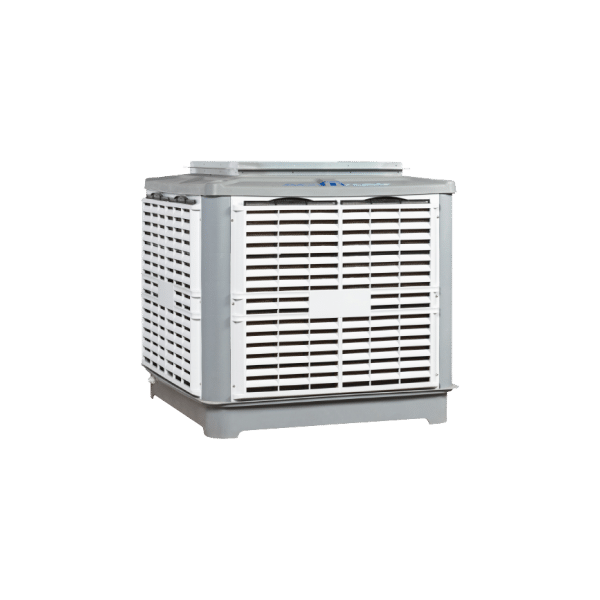
Portable evaporative coolers can work in humid climates, but their performance depends heavily on the site conditions. For a business, the determiner is whether it’s the right cooling method for the space, the weather airflow and the operational risks involved.
The wrong hire decision can lead to unhappy patrons, disrupted production or wasted temperature-sensitive goods.
How evaporative cooling works
Evaporative cooling uses a simple physical process. Warm outside air is drawn through water-saturated pads. As the water evaporates, it absorbs heat from the air. Cooler air is then pushed into the space.
This is why evaporative cooling is often effective in hot, dry conditions. Unlike refrigerated air conditioning, evaporative cooling does not recirculate sealed indoor air. It relies on fresh air and steady air movement. That makes ventilation essential. Doors, windows, vents or exhaust points need to allow air to leave the building. Without that air exchange, moisture builds up and performance drops.
Why humidity changes the result
Humidity affects evaporative cooling because air can only absorb a certain amount of moisture. This is referred to as relative humidity, the ratio between the moisture actually in the air and the maximum amount the air could hold at the same temp.
Remember, evaporative cooling works by adding a small amount of moisture to the air to help remove heat. When relative humidity is high, the air is already holding a significant amount of moisture. That leaves less capacity for evaporation, which means less heat is removed from the air. This is also why humid conditions can feel so uncomfortable. Sweat doesn’t evaporate as efficiently from the skin, making it harder for the body to cool itself.
For a business site, you have to look at temperature in context. A 35°C day in inland South Australia is very different from a 35°C day in coastal Queensland. The temperature may look the same on paper, but the cooling strategy may need to be completely different.
So, does evaporative cooling work in humid climates?
Yes, but with glaring limitations.
Evaporative cooling can still provide airflow and some cooling benefit in humid conditions, particularly in outdoor, semi-outdoor or well-ventilated environments. It may suit temporary comfort cooling for certain worksites, loading areas, marquees, open warehouses or event zones where air movement is valuable.
However, it should not be treated as a direct replacement for refrigerated air conditioning in enclosed, humid spaces. A technical review of evaporative cooling systems notes that conventional direct evaporative cooling cannot reduce air temperature below the wet-bulb temperature of the air. In practical terms, humid air places a hard limit on how much cooling the system can achieve.
When a portable evaporative air cooler is the right choice
In dry climates, evaporative cooling can be efficient, scalable and fast to deploy. In more humid regions, it needs more careful assessment. A portable evaporative air cooler may be the right hire choice when the project needs temporary comfort cooling rather than strict temperature control.
It’s often suitable when:
- The site has low to moderate humidity
- The area is open or semi-open
- There is a clear path for fresh air in and moist air out
- The cooling requirement is temporary
- The priority is staff, guest or patron comfort
- Power access is limited compared with larger refrigerated systems
- Fast setup is important
Portable evaporative units are great for targeted cooling, such as near work zones, event areas, temporary dining spaces or places where staff are exposed to radiant heat.
They are not designed to turn a sealed, humid space into a tightly controlled indoor environment. That job usually belongs to refrigerated cooling, dehumidification or a more engineered climate control system.
When evaporative cooling may not be enough
Evaporative cooling is not the best answer for every site, as it’s unsuitable where added moisture creates risk, where ventilation is poor or where temperature and humidity need to stay within a narrow range.
Businesses should be cautious using evaporative cooling for:
- Server rooms and data centres
- Healthcare environments
- Food and beverage production
- Cold storage areas
- Enclosed offices in humid regions
- Retail environments with limited ventilation
- Spaces containing moisture-sensitive materials
- Any site requiring precise temperature control
In these cases, portable air conditioning units may be more appropriate. The safest approach is to match the equipment to the risk, not just the square metreage.
Get the right temporary cooling system for your site
To restate, evaporative cooling can be an effective temporary solution when the conditions are right. It performs best in hot, dry climates and in spaces with strong ventilation. In humid climates, it can still help with airflow and comfort, but expectations need to be realistic.
The best outcome comes from choosing the system that matches the site. That may be a portable evaporative air cooler, portable air conditioning, dehumidification, refrigeration, chillers or a complete temporary climate control setup.
Active Air supports businesses with temporary climate control and power solutions across Australia, with equipment options spanning cooling, heating, dehumidification, power distribution and more. When comfort and operational certainty matter, the right advice is as important as the equipment itself. Talk to us today.